

The Climate Problem
Why Houston's Climate Is Unique for Windows
Houston has one of the most demanding climates for windows in the United States. What works in Minnesota won't work here — the combination of extreme heat, high humidity, and hurricane-season rain requires a specific set of window features.
The same logic applies across the metro: a home in Katy baking under west-facing afternoon sun, a two-story in Sugar Land with floor-to-ceiling glass, a wooded lot in The Woodlands, or a new build out in Cypress, Spring, or Tomball — they all share the same enemy: solar heat gain measured in months, not weeks.
The One Spec That Matters Most
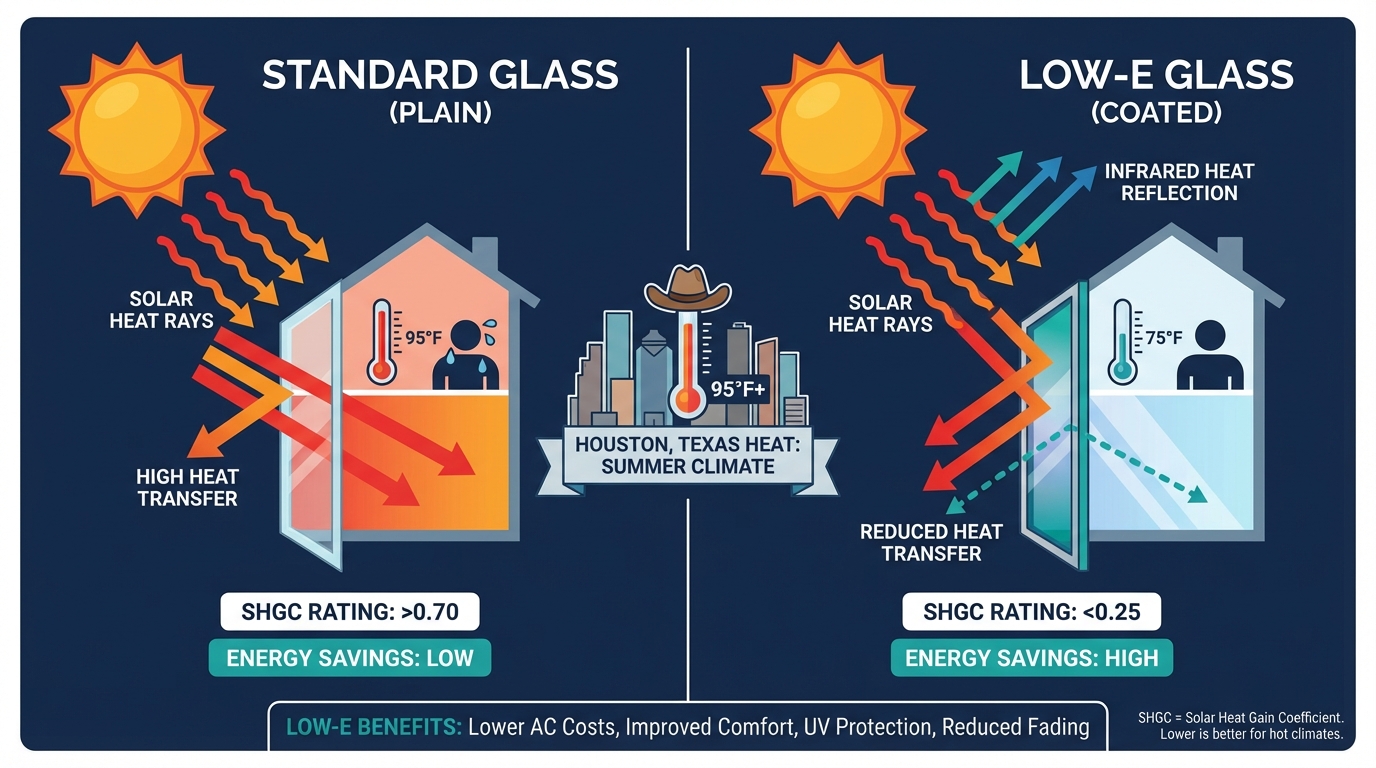
The #1 Feature for Houston: Solar Heat Gain Coefficient (SHGC)
In cold climates, you want windows that let heat in (high SHGC). In Houston, you want the opposite — windows that block solar heat while still admitting daylight.
"SHGC matters more than U-factor in Houston. We're not worried about keeping cold out — we're fighting to keep heat out."
For south- and west-facing windows, compare low-SHGC options using the NFRC label. ENERGY STAR criteria are a certification floor, not a guarantee that one glass package is optimal for every opening; orientation, shading, visible light, and whole-window U-factor also matter.
Low-E Glass: Non-Negotiable in Houston
We see the difference clearly when comparing a Pearland retrofit to a same-era home in Richmond — the Low-E house runs noticeably cooler upstairs by mid-afternoon.
Choosing Your Frame
Frame Material: What to Choose
Vinyl frames are the right choice for most Houston homes — won't rot in high humidity, doesn't conduct heat like aluminum, low maintenance, and most affordable.
Fiberglass is a premium option — more dimensionally stable in extreme heat. Worth it for high-end homes.
Avoid aluminum for residential replacement. Aluminum conducts heat aggressively — a real problem in Texas summers.
If we could ban one window from the Houston market, it would be aluminum residential. It's a heat sink bolted into your wall.
ENERGY STAR Certification for Houston
ENERGY STAR and NFRC criteria change over time, so compare the current whole-window U-factor and SHGC on the product label for the Houston climate. Certification does not create a federal tax credit for a 2026 installation.
Our Recommendation for Houston Homes
The sweet spot for most Houston homeowners:
- Vinyl frame (double-hung or casement depending on your home)
- Double-pane Low-E glass with argon fill
- Low SHGC appropriate for the opening's orientation and shading
- ENERGY STAR Southern-zone certified
This combination delivers strong energy performance at a reasonable price point. We've installed it from Rosenberg and Fulshear to Greatwood, Missouri City, and as far south as Needville. Questions about your specific home? Call us at (713) 636-5145 and we will explain the options for your house.
Frequently Asked Questions
Q.Is Low-E glass really worth it over clear double-pane in Houston?
Yes — and it isn't close. Clear double-pane lets roughly 75% of solar heat through; quality Low-E blocks 60–70% of that heat while still passing 70%+ of visible light. In a 160-day cooling season, the cooling-bill delta typically pays back the $50–$100 per-window upcharge in 2–3 summers. We won't quote a non-Low-E package for a Houston home.
Q.Single-pane vs. double-pane in Houston — is double really necessary?
Low-E is important in Houston because it reduces solar heat gain while preserving daylight. Compare the whole-window U-factor and SHGC on the current NFRC label rather than relying only on pane count or a generic product description.
Q.Do I need hurricane impact-rated windows in the Houston metro?
Inland Houston is outside the Texas Windstorm Insurance Association coastal designation, so impact glass isn't code-required for most of Harris and Fort Bend counties. It's still a worthwhile upgrade for homes south of I-10 or near the Gulf — laminated impact glass adds roughly 25–40% to window cost but provides debris protection during tropical systems and can earn an insurance discount. For most homeowners, standard Low-E double-pane is the right call.
Q.Vinyl vs. fiberglass — which holds up better in Texas heat?
Both work in Houston when specified correctly. Quality vinyl (welded corners, internal reinforcement) handles the heat fine and is the value play for 90% of homes. Fiberglass expands and contracts at roughly the same rate as glass, which makes it more dimensionally stable on large units and west-facing exposures — worth the 15–30% premium on premium homes or oversized windows. Avoid cheap builder-grade vinyl with mechanically-fastened corners; that's where heat-related failures show up.
Q.What exactly does ENERGY STAR Southern-zone certification require?
ENERGY STAR criteria are version-specific. Ask for current Southern-zone certification and compare the NFRC whole-window U-factor and SHGC shown for the exact product. Those ratings are more reliable than a salesperson's generic description.
Q.How long should replacement windows last in Houston's climate, and should I worry about condensation?
Service life varies widely with product design, exposure, installation, maintenance, and hardware or seal quality, so a fixed 25-, 30-, or 35-year promise is not reliable. Interior-surface condensation can reflect indoor humidity, outdoor temperature, glass temperature, or airflow. Condensation between panes usually indicates an insulated-glass seal failure; the remedy may be an insulated-glass-unit replacement or a full window replacement, depending on the product and warranty.


